




How Ford is Poised to Tackle EV Production Hiccups
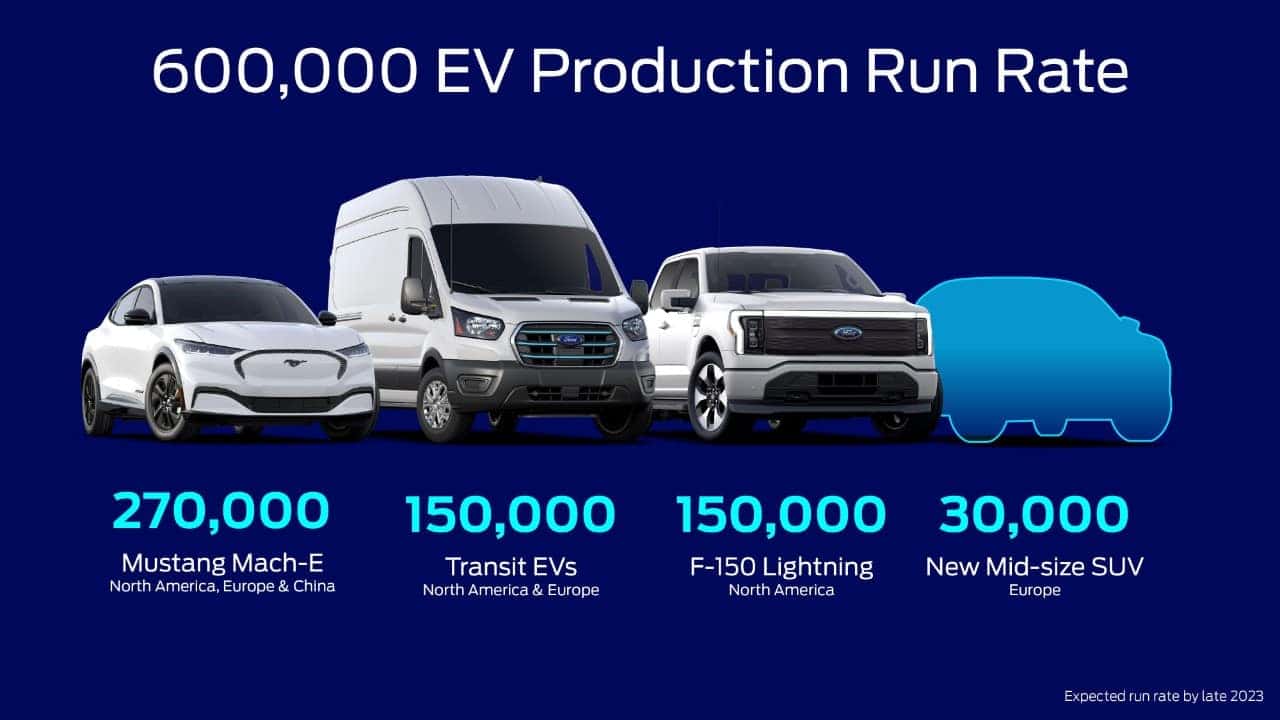
Thanks to strong demand for its EVs, Ford recently announced a series of initiatives meant to tackle production problems–including sources of battery capacity and raw materials. Ford has a targeted annual run rate of 600,000 EVs by late 2023, while hoping to ramp up production to 2 million units by the end of 2026. The automaker detailed its plans to conquer the global EV market as part of its Ford+ plan as the growth rate of EVs is projected to surpass 90 percent by 2026.
“Ford’s new electric vehicle lineup has generated huge enthusiasm and demand, and now we are putting the industrial system in place to scale quickly. Our Model e team has moved with speed, focus and creativity to secure the battery capacity and raw materials we need to deliver breakthrough of EVs for millions of customers,” said Jim Farley, Ford’s President and CEO and President of Ford Model e.
Ford is looking to invest more than $50 billion in EVs through the 2026 model year. As the automaker commits to sustainability and human rights, it also plans to make half of its global production EVs by 2030, with hopes of achieving carbon neutrality by 2050 at the latest. To avoid hiccups in the future of its full-scale EV production, Ford is adding lithium iron phosphate cell chemistry to its already-large portfolio. Creating even more capacity for the automaker’s high-demand products is the key to avoiding production problems in the future, especially so that owners can have years of operation with minimal range loss as batteries age. Additionally, Ford’s latest expansion reduces the brand’s reliance on critical minerals such as nickel, which is increasingly scarce. Ford confirmed it secured 100 percent of its annual battery cell capacity needed to support its ambitious plans of producing 600,000 EVs around the world.
“Our team has been actively engaged with partners in the United States and around the world. We will move fast in the key markets and regions where critical supplies are available, meeting with government officials, mining companies and processors and signing MOUs and agreements that reflect Ford’s ESG expectations and underpin Ford’s plan to bring EVs to millions,” said Lisa Drake, Ford Model e vice president, EV Industrialization.
Ford is decidedly going to change the EV supply chain, and a large part of the effort can be credited to the consumer praise the automaker received for its first-generation EV models. Overwhelming demand for EVs makes it clear to Ford that the pool of potential EV buyers continues to grow. According to a recent study, the majority of consumers looking to buy a new vehicle within the next two years are looking to opt for an EV or hybrid vehicle– an impressive 11 percent uptick from last year (2021). Additionally, a large part of that increase is for full-on EVs, not hybrids. As for commercial owners, 60 percent of U.S. fleet managers surveyed indicated to Ford that they plan to add EVs to their operations within the next two years as well.
Learn more about the upcoming Ford innovations via Wayne Akers Ford social media. Whether you’re ready to make the switch to electric, or want to go a more conventional route, Wayne Akers Ford has you covered with the latest Ford inventory. Explore the Ford F-150 Lightning, Ford Mustang Mach-E, and many other models here at Wayne Akers Ford.
Photo Source/Copyright: Ford